Introduction
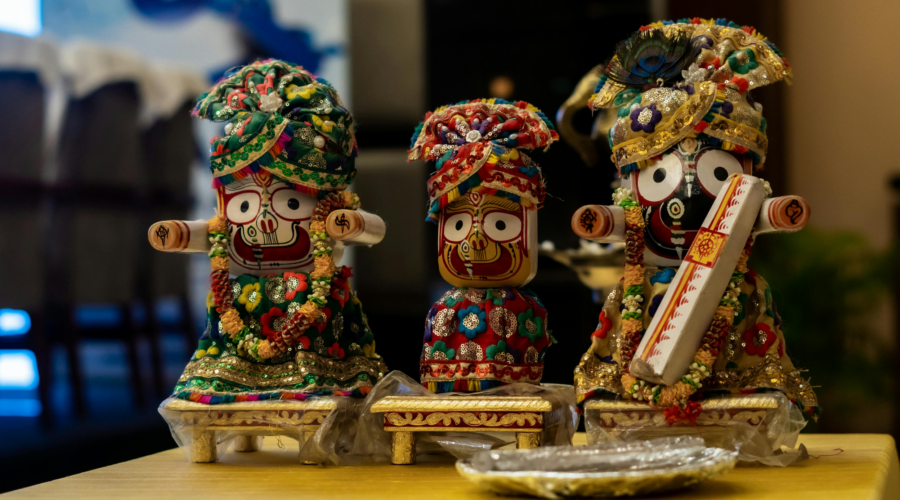
As millions of devotees across India and around the world gather to celebrate the annual Rath Yatra of Lord Jagannath, the air is filled with faith, devotion, and centuries-old tradition. Originating from the 12th-century Jagannath Temple in Puri (one of India’s four sacred Char Dham pilgrimage sites), the festival is much more than a religious procession; it is a living testament to India’s rich cultural and spiritual heritage.
Against this backdrop, a recent legal development caught my attention. The Shree Jagannath Temple Administration, Puri (“SJTA”) has applied for trademark registration of the word marks ‘Patitapabana’ (Application No. 7304900 – Marked for examination) and ‘Ananda Bajara’ (Application No. 7280310 – Objected) under Class 45, along with the iconic ‘Neelachakra’ logo (Application No. 7279907 – Accepted & Advertised) and 26 other marks. While these applications sparked a wave of criticism and reignited debates on whether religious terms and symbols should receive trademark protection, they also present an opportunity to reconsider an important question: Can trademark law extend beyond protecting commercial brands to safeguarding religious heritage?
The Rationale behind seeking Trademark Protection
To understand the intent behind SJTA’s trademark applications, it is important to examine the concerns that prompted them. The applications were filed amidst growing instances of commercial use of names and symbols associated with Lord Jagannath. These concerns were further amplified by the controversy surrounding the use of the expression “Jagannath Dham” for a newly inaugurated temple in Digha, West Bengal, which the Odisha Government opposed on the ground that the title has historically been associated with Puri.
The trademark applications are not limited to the name “Jagannath” itself. They extend to identifiers that are uniquely intertwined with the Temple’s history and traditions. These include:

- ‘Patitapabana’, the revered form of Lord Jagannath installed near the Singhadwara (Lion Gate) to enable darshan for devotees unable to enter the temple;
- ‘Ananda Bajara’, the sacred marketplace within the Temple premises where Mahaprasad is distributed; and the iconic
- ‘Neelachakra’, the distinctive eight-spoked metal disc mounted atop the Temple’s spire.
Each of these marks represents far more than a commercial identifier, they embody centuries of religious tradition, public recognition, and cultural goodwill. Viewed in this context, the Temple Administration’s objective appears not to claim exclusive rights over faith or religious practice, but to prevent unauthorised commercial appropriation of symbols that have become inseparable from the identity and reputation of the Jagannath Temple.
Validity Under Trade Marks Act, 1999
The controversy surrounding the SJTA’s trademark applications invites a closer examination of the statutory framework governing trademarks. Section 2(1)(zb) of the Trade Marks Act, 1999 defines a trademark as:
“a mark capable of being represented graphically and which is capable of distinguishing the goods or services of one person from those of others and may include shape of goods, their packaging and combination of colours.”
The SJTA has sought protection under Class 45 of the Nice Classification, which covers personal and social services rendered by others to meet the needs of individuals.
Much of the criticism surrounding the applications has centred on the absolute grounds for refusal under Section 9 of the Act. Several commentators have argued that expressions such as ‘Patitapabana’ and ‘Ananda Bajara’, being deeply embedded in the religious vocabulary of devotees, ought to be refused registration under Section 9(1)(c), which provides that:
“trademarks which consist exclusively of marks or indications which have become customary in the current language or in the bona fide and established practices of the trade shall not be registered.”
According to this line of reasoning, these expressions have existed in the public domain for centuries and are commonly used by devotees in their everyday religious practices. Consequently, questions have been raised as to whether such terms are capable of functioning as trademarks, whether their registration would impede public use, and whether any single institution can legitimately claim exclusive rights over identifiers that have acquired widespread religious significance.
The SJTA, however, adopted a different stance in its response to the Examination Report. It contended that the expressions have, by virtue of honest adoption and continuous use in relation to the services covered under Class 45, acquired a distinctive secondary meaning. According to the Administration, the marks have developed considerable goodwill and reputation among devotees and the public, enabling them to function as source identifiers uniquely associated with the services rendered by the Temple Administration. It was therefore argued that the marks are entitled to registration and deserve a high degree of legal protection.
Another criticism advanced by legal commentators is that granting trademark protection would offend Section 9(2)(b) of the Act, which prohibits registration of a mark:
“if it contains or comprises of any matter likely to hurt the religious susceptibilities of any class or section of the citizens of India.”
However, this interpretation appears to stretch the provision beyond its intended purpose. Section 9(2)(b) is aimed at preventing the registration of marks that employ religious names or symbols in an offensive or sacrilegious manner. For instance, using the name of a Hindu deity for beef products or that of an Islamic religious figure for pork products. The SJTA’s applications stand on an entirely different footing. Rather than using sacred expressions in a manner that is likely to offend religious sentiments, they seek to prevent unauthorised commercial exploitation of identifiers intrinsically associated with the Jagannath Temple. Consequently, there is a strong argument that equating these applications with marks prohibited under Section 9(2)(b) appears to be a misplaced application of the provision.
Earlier Judicial Precedent
An earlier judicial precedent of Kerala High Court assumes particular significance while examining the SJTA’s trademark applications. In Suo motu Proceedings v. Controller General of Patents, Design and Trademarks, the Attukal Bhagawathy Temple Trust (“Trust”) had obtained trademark registrations for the picture of its deity (Trademark No. 1420800) and the appellation ‘Sabarimala of Women’ (Trademark No. 1420799) under Class 42 in respect of temple services, social services, welfare services, and cultural activities. The Division Bench of the Kerala High Court took suo motu cognisance of these registrations in 2009 pursuant to a petition faxed by Mr. Praveen Raj.
Having considered the nature of the marks and their association with the Temple, the Court held:
“It is the definite pleading of the Trust as also the official respondents that the picture and the appellation have acquired a distinctive character in relation to the activities and services above specified and related to the temple, as a result of a long and uninterrupted user as is provided under Section 9 of the Act. We also do not see any prohibition from granting registration of the picture and appellation to the Temple Trust under the provisions of the Act or the Rules.”
An apprehension was also raised before the Court that granting trademark protection would confer exclusivity over the picture of the deity and consequently restrict the rights of devotees. The Trust, however, clarified:
“It is not their intention to restrict the rights of the devotees to worship the deity of the temple and that it was only their intention to prohibit the use of the picture of the deity and the appellation for services protected under the registration.”
The Trust further emphasized that the registrations would merely prohibit the unauthorised use of the picture and appellation in relation to the specified services and would have no bearing on the religious rights of devotees. This reasoning closely mirrors the rationale underlying the SJTA’s applications. Rather than seeking to monopolise faith or religious practice, the objective appears to be the protection of identifiers that have acquired immense goodwill and distinctiveness through their longstanding association with the Jagannath Temple, while preventing their unauthorised commercial exploitation.
Conclusion
In conclusion, although the SJTA’s trademark applications are still pending registration, they have undoubtedly ignited an important conversation on the evolving role of trademark law. Traditionally, trademarks have been viewed as instruments for protecting commercial brands, products, and consumer goodwill. However, the present applications demonstrate that trademark law is increasingly being invoked to safeguard cultural heritage, and religious symbols that have acquired immense goodwill through centuries of public association.
In a country like India, where religion forms an integral part of the social and cultural fabric, sacred names and symbols are equally susceptible to unauthorised commercial exploitation and misleading use. In such circumstances, trademark law, by virtue of its source-identifying function, has the potential to curb misuse, preserve authenticity, and protect the reputation of revered religious institutions. Properly calibrated, such protection does not amount to monopolising faith; rather, it ensures that the goodwill associated with these sacred identifiers is not commercially appropriated to the detriment of both the institution and the devotees.
References:
Primary Sources:
- Trademarks Act, 1999
- Nice Classification
- Trademarks Registry
- Suo motu Proceedings v. Controller General of Patents, Design and Trademarks, 2013 SCC OnLine Ker 24367 (India)
Secondary Sources:
- Subhalaxmi Mukherjee, ‘Can Purely Religious Terms be Trademarked? The Curious Case of “Shree Jagannath Dham”’ (SpicyIP, 22 August 2025) https://spicyip.com/2025/08/can-purely-religious-terms-be-trademarked-the-curious-case-of-shree-jagannath-dham.html accessed 20 July 2026
- Ananya Kumar Srivastava, ‘Can Faith Be Trademarked? A Legal Analysis of the Neelachakra and Jagannath Temple Trademarks’ (Centre for Policies, Laws and Agenda (CPLAN), 6 July 2026 https://cplan.in/can-faith-be-trademarked-a-legal-analysis-of-the-neelachakra-and-jagannath-temple-trademarks/ accessed 20 July 2026
The post was written by our intern – Ms. Diksha Hans
Giving credit where it’s due: The words are ours; the beautiful images are courtesy of talented creators across third-party platforms and used in accordance with their applicable licence terms.